Updated November 7, 2026
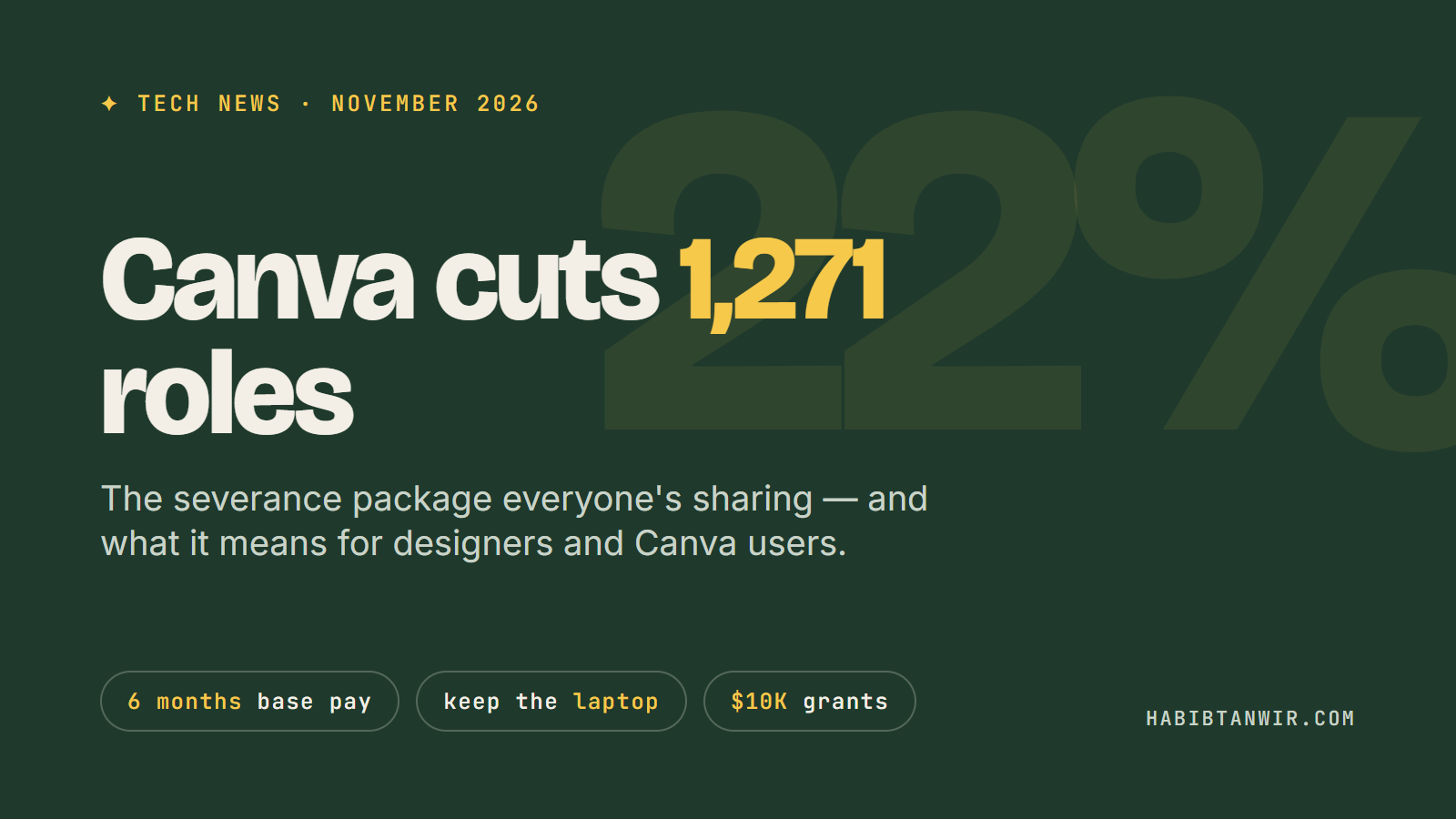
On November 3, 2026, Canva CEO Melanie Perkins told staff that 1,271 people, about 22% of the company, will be affected by a restructuring. Some will lose their jobs, some will move into new roles, and some will be asked to relocate to Canva's central hubs. Canva has not said how many of the 1,271 are actual job losses.
What made this story spread on LinkedIn wasn't the cut itself. It was the exit package. Below is what happened, what affected employees get, and what it means if you use Canva every day, as a business owner, a designer or someone who sells Canva templates (like me).
What Canva announced
According to the memo, which Canva also posted on its website, and reporting from Bloomberg and TechCrunch:
- 1,271 roles affected, roughly 22% of the workforce: a mix of layoffs, role changes and relocations.
- Teams are merging. Product, growth and platform become one product organisation, with fewer layers of management and fewer narrow specialist roles.
- Which teams and countries are hit hardest hasn't been disclosed.
TechCrunch quotes Perkins calling this "our hardest year yet". Inc. reports that she framed the change as a "refounding" of the company.
Why it's happening
The main reason given is growth. Perkins said Canva's growth slowed for the first time in a decade, and pointed to fast technology change and shifting user expectations.
Most coverage connects that to AI. People can now generate a poster, a logo or a whole slide deck from a sentence, in ChatGPT and in a wave of new AI design tools. Bloomberg frames the overhaul as AI-driven, and TechCrunch points to competition from AI startups and general-purpose chatbots. But, as Inc. notes, the memo itself doesn't name AI as the reason. A fair reading is: AI is changing what people expect from a design tool, and Canva is reorganising to move faster.
The severance package everyone is talking about
Based on Fortune, Fast Company and other reports, employees who leave get:
| What | Details |
|---|---|
| Pay | At least 6 months of base pay, in every country |
| Healthcare | Coverage continues for 12 months, where Canva provides it |
| Laptop | They keep their work laptop |
| Job search | 12 months of LinkedIn Premium, career coaching, interview prep and CV help |
| Starting something | Grants of about $10,000 for people starting a business or community project |
| Equity | Some outlets report the one-year vesting cliff was waived, so recent hires keep their shares |
For comparison, many tech layoffs come with a few weeks of pay per year worked and a same-day laptop return. Six months' pay worldwide is unusually generous, which is why so many people shared it.
It's still a layoff. A good package makes the exit easier, but people are losing jobs they wanted to keep.
Does this change anything for Canva users?
For most people, nothing changes this week: the announcement is about how Canva is organised, not about the product or plans you use today. A few things are worth watching:
- More AI inside Canva. A company that reorganises "to move faster" in a market shaped by AI will almost certainly ship more AI features: generating designs, resizing, writing copy. Expect the editor to keep changing.
- Fewer, bigger features. Merging teams usually means fewer side projects and more focus on core products. Some smaller features may get less attention.
- Pricing. Slowing growth puts pressure on revenue. Nothing has been announced, but price changes on paid plans wouldn't be surprising over the next year.
What it means if you design or sell templates
I sell Canva templates myself (carousels and social posts on my templates page), so I've been thinking about this from that side too.
- Generic templates are getting easier to replace. If AI can produce a "simple Instagram post" in seconds, a basic template is worth less. Specific, well-structured templates, like a complete 10-slide launch carousel with a clear story, are harder to replace with one prompt.
- Don't put everything on one platform. Keep your own copies of your work (export your designs) and your own website, so a policy or pricing change on any one tool doesn't take your business with it.
- Taste still matters. Layout, hierarchy and knowing what makes someone stop scrolling are what clients pay for. AI makes the first draft faster. It doesn't decide what's good.
What other companies can learn
Whatever you think of the cuts, the way Canva handled the exit is a useful model:
- Say what's happening and why, in a memo everyone can read.
- Give people time. Six months of pay lets someone find the right next job, not the first one.
- Remove small cruelties. Letting people keep their laptop and their unvested shares costs a company little and means a lot to the person leaving.
Sources
- Bloomberg: Canva Cuts Jobs, Restructures Workforce as Growth Slows for First Time
- TechCrunch: Canva lays off over 1,200 people amid slowing growth
- Fortune: Canva is restructuring 22% of its workforce, and LinkedIn is applauding the exit package
- Fast Company: Canva's restructuring affects 1,200+ people, but its severance package is earning praise
- Inc.: Canva's CEO says the company needs to be "refounded"
- NDTV: Canva layoffs and severance package